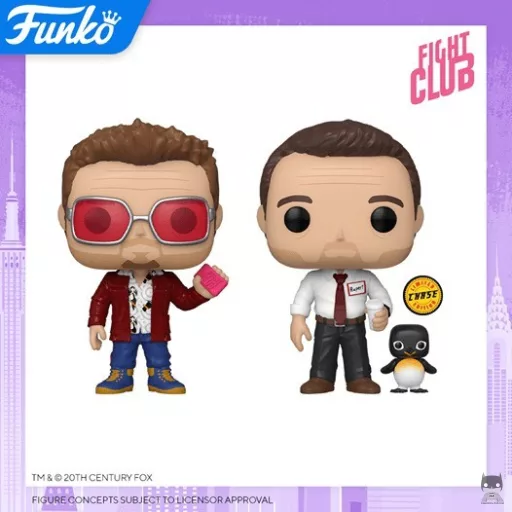
Discover the Fight Club figures
It seems hard to believe today that Fight Club, when it was released in 1999, received a very mixed reception from the audience. It was a relative success compared to what was hoped for. Indeed, the project Fight Club, in the cinema, was carrying many expectations. Expectations that were respected to the letter and even went beyond what the spectator could have expected. Indeed, one does not emerge unscathed from such a film, or rather, from such an adaptation.
Before being a movie, Fight Club was a novel by the atypical and anti-conformist writer Chuck Palahniuk. The aura of cursed writer of its author made Fight Club a sulphurous work. It is still for this reason that it was obviously brought to the big screen. And with what brilliance ... It is indeed David Fincher who found himself behind the camera. So, with a renowned director, a deep and powerful best-selling novel, and top-notch actors, everything predicted Fight Club to fill theaters. But it was not to be. The film's success came only later, when it was released on DVD.
This mistrust of the spectators was due to the criticism that was made of the film. The critics, who were notoriously composed of flaky freelancers with too little critical thinking to have any taste, had denounced Fight Club with all their might. This, then, had an impact on its media coverage and success. At least, at first. Because even the strongest dam could never have prevented the tidal wave of Fight Club.
With Brad Pitt and Edward Norton as the main characters, Fight Club was a monument to non-conformity. The most unhappy viewers saw it as an insidious eulogy of fascism, while lucid viewers saw it as a grandiose work. The sale of his DVDs avenged David Fincher of the critics. Fight Club is now recognized as the favorite film of the Allociné community and is in the top 10 of many best film rankings. Never has such a praise of rebellion been so powerful.
The story follows a protagonist whose name the viewer will never know. He is a man who has given in to the consumer society, which is taking up more and more space in his life. He is alone, lives only to work and consume and does not find sleep anymore. It is later in this stage of his life that he meets Tyler Durden, a man who represents everything he would have liked to be.
Through an unfortunate coincidence, the two men find themselves living together. Little by little, the main character, in contact with him, will let himself go to the marginality. Totally emancipated from the consumer society, swearing only by the Fight Club that Tyler and him have set up, he wallows in non-conformism and has the feeling of finally living again. But Fight Club, as it grows in membership, evolves. What was intended to be an underground fight group where all the reprobates met gradually becomes a terrorist organization that does not say its name. Overcome by events, the main character becomes, in spite of himself, the leader of a secret army ready for the worst exactions.
With a dark tone, a direction out of the box and spectacular actors, Fight Club consecrated Tyler Durden as the most credible figure of the rebel. Not the rebel for the sake of posing as James Dean could be, but the truly subversive rebel who, with one sentence, can cause a revolution. It's no wonder then that such an icon finds its place as a Funko POP Fight Club figure. One of the most beloved movies in the world could not do without such an idol.